This article was last updated on:
If you’re a brand looking to grow sales without inflating your marketing budget, the benefits of affiliate marketing for brands are hard to ignore. Unlike traditional advertising, where you pay upfront and hope for results, affiliate marketing flips the model – you only pay when a sale, lead, or install actually happens.
From fast-growing e-commerce businesses to global SaaS companies, brands across every category are turning to affiliate programs to acquire new customers, scale their reach, and improve return on ad spend. In Southeast Asia alone, the affiliate marketing industry has grown significantly over the past five years, driven by the rise of content creators, deal sites, and performance-focused publishers.
In this guide, we break down every major benefit of affiliate marketing for brands – and show you exactly how to get started through Involve Asia’s advertiser network.
TL;DR: Affiliate marketing lets brands pay only for results, reach new audiences through trusted publishers, and scale revenue without scaling ad spend. Key benefits include performance-based ROI, access to a diverse publisher network, low risk, expanded market reach, and real-time tracking.

What Is Affiliate Marketing for Brands?
Affiliate marketing is a performance-based channel where brands (advertisers) partner with publishers – bloggers, influencers, deal sites, cashback platforms, and app developers – who promote the brand’s products or services in exchange for a commission on each successful conversion.
The brand sets the commission structure (e.g. a percentage of sale, a fixed amount per lead, or a cost-per-install). Publishers apply to join the program, generate unique tracking links, and earn every time their audience converts. An affiliate network like Involve Asia sits in the middle – managing tracking, attribution, payments, and publisher relationships on the brand’s behalf.
This model is fundamentally different from display or social advertising. There are no impressions to buy, no CPM rates to negotiate, and no wasted spend on audiences that don’t convert. Every dollar spent maps directly to a result.
What Are the Key Benefits of Affiliate Marketing for Brands?
1. You Only Pay for Real Results
The most cited benefit of affiliate marketing for brands is its performance-based payment model. Unlike pay-per-click or display advertising – where you pay regardless of whether the audience converts – affiliate marketing means your spend is directly tied to outcomes. Whether your goal is a completed purchase (CPS), a qualified lead (CPL), or an app install (CPI), you define what a “conversion” means and only pay when it happens.
This makes affiliate marketing one of the most capital-efficient channels available, particularly for brands that are cost-conscious or operating in competitive markets with high customer acquisition costs.
2. Access to a Large, Diverse Publisher Network
When you launch an affiliate program through a network like Involve Asia, you instantly gain access to thousands of vetted publishers across multiple traffic types – content blogs, review sites, coupon and cashback platforms, social media influencers, email marketers, and app-based publishers.
Each publisher type brings a different audience, a different content format, and a different conversion pathway. A cashback site drives price-sensitive shoppers. A tech reviewer drives considered buyers. A lifestyle influencer drives impulse purchases. By running a single affiliate program, you activate all of these simultaneously – without managing individual partnerships yourself.
3. Low Risk, High Scalability
Because affiliate marketing is performance-based, scaling up carries minimal financial risk. If a publisher drives 10x more conversions next month, your cost scales proportionally – and you only pay more because you earned more. Compare this to paid media, where scaling spend often means diminishing returns and rising CPMs.
This makes affiliate marketing exceptionally well-suited for brands that want to grow aggressively without taking on disproportionate risk in their marketing budget.
4. Expanded Reach Across New Markets and GEOs
One of the most underappreciated benefits of affiliate marketing for brands is geographic expansion. Through a regional network like Involve Asia, brands can reach audiences across Southeast Asia, South Asia, and beyond – through publishers who already have established audiences in those markets.
Rather than building brand awareness in a new country from scratch, you can tap into publishers who already speak the local language, understand local buying behaviour, and have built trust with local audiences. This dramatically lowers the barrier to entering new markets.
5. Increased Brand Credibility Through Publisher Endorsement
Publishers – especially content creators, bloggers, and reviewers – build their audiences on trust. When a respected tech reviewer recommends your product or a popular cashback platform lists your offer, it carries more weight than a banner ad. Affiliate marketing lets your brand benefit from the credibility publishers have already built with their audiences.
This is especially valuable for newer brands looking to establish trust quickly, or established brands entering a new product category where they have less authority.
6. Real-Time Performance Tracking and Attribution
Modern affiliate networks provide dashboards with real-time data on clicks, conversions, revenue, publisher performance, and return on ad spend. Brands can see exactly which publishers are driving results, which traffic sources convert best, and where to increase or decrease commission investment.
This level of transparency is often superior to other marketing channels. You know which content piece drove a sale, which publisher’s audience converts at the highest rate, and which GEOs are your best performers.
7. Cost-Effective Customer Acquisition
Customer acquisition cost (CAC) is one of the most important metrics for any brand. Affiliate marketing consistently delivers competitive CAC because the channel is self-optimising – publishers who don’t convert stop promoting (since they earn nothing), while high-performing publishers scale up. Over time, your affiliate program naturally concentrates on the publishers and strategies that produce the best results for your brand.
8. SEO and Content Benefits
When publishers create content to promote your brand – reviews, comparison posts, how-to guides, YouTube videos – they often include backlinks to your website. These backlinks contribute to your domain authority and can drive organic traffic long after the original campaign. Unlike paid ads that stop driving traffic the moment you stop spending, publisher content can continue generating results for months or years.
How Does Affiliate Marketing Compare to Other Channels?
| Channel | Payment model | Risk level | Scalability | Attribution clarity |
|---|---|---|---|---|
| Affiliate marketing | Pay per result (CPS / CPL / CPI) | Low | High | High |
| Display advertising | CPM (per 1,000 impressions) | Medium | Medium | Low |
| Paid search (SEM) | CPC (per click) | Medium–High | Medium | Medium |
| Influencer marketing | Flat fee per post | High | Low | Low |
| Email marketing | Fixed platform cost | Low | Medium | Medium |
Affiliate marketing stands out for combining low risk, high scalability, and strong attribution – a combination that few other channels can match.
What Types of Brands Benefit Most from Affiliate Marketing?
While virtually any brand can benefit from affiliate marketing, some categories see especially strong results:
- E-commerce brands – High product volume, frequent promotions, and transactional audiences make e-commerce a natural fit for CPS affiliate programs.
- Travel and hospitality – Hotels, airlines, and booking platforms benefit from the reach of travel bloggers, deal aggregators, and cashback platforms.
- Finance and fintech – Credit cards, loans, insurance, and digital banking products are heavily promoted via CPL affiliate models.
- Software and SaaS – Subscription products with recurring revenue can offer generous commissions while maintaining strong LTV ratios.
- Health and beauty – High repeat purchase rates and strong social media presence make health and beauty ideal for influencer-led affiliate programs.
- Digital products and apps – CPI (cost-per-install) models are highly effective for mobile apps looking to grow their user base cost-efficiently.
How Can Brands Get Started with Affiliate Marketing on Involve Asia?
Step 1 – Sign Up as an Advertiser
Register your interest to become an advertiser on Involve Asia. The onboarding process is straightforward – you’ll set up your brand profile, define your offer type (CPS, CPL, or CPI), and configure your commission structure.
Step 2 – Set Up Your Offer
Define the terms of your affiliate program: commission rates, cookie period, eligible traffic sources, prohibited channels, and any market or GEO restrictions. Involve Asia’s team can advise on competitive benchmarks for your category.
Step 3 – Get Approved and Go Live
Once your offer is reviewed and approved, it goes live in the Involve Asia publisher marketplace – instantly visible to thousands of active publishers across Southeast Asia and beyond.
Step 4 – Monitor, Optimise, and Scale
Use the Involve Asia dashboard to track performance in real time. Identify your top-performing publishers, adjust commissions to incentivise higher-value traffic, and run upsize commission events during key campaign periods to maximise results.
5 Common Mistakes Brands Make with Affiliate Marketing
- Setting commissions too low – Publishers have many brands to choose from. Uncompetitive rates mean fewer publishers will prioritise promoting your offer.
- Not communicating campaign updates – Publishers perform better when they know about upcoming promotions, seasonal offers, and commission changes in advance.
- Neglecting publisher relationships – Your top publishers are partners, not just traffic sources. Regular communication, exclusive offers, and co-marketing opportunities build stronger long-term results.
- Skipping traffic source rules – Failing to clearly define which traffic sources are allowed (and which are prohibited) can lead to low-quality conversions or compliance issues.
- Measuring only last-click attribution – Affiliate marketing contributes to the full customer journey. Brands that only look at last-click data may undervalue upper-funnel publisher types like content bloggers and review sites.
Why Run Your Affiliate Program Through Involve Asia?
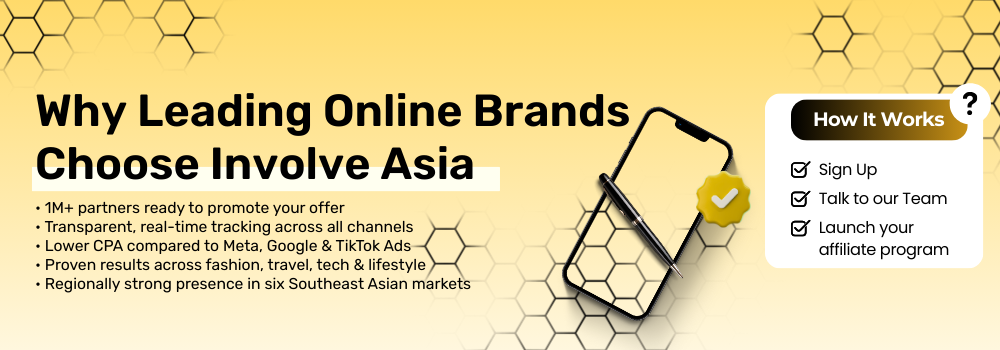
Involve Asia is Southeast Asia’s leading affiliate marketing network, connecting brands with over one million publishers across the region. Here’s what sets it apart for advertisers:
- Regional expertise – Deep knowledge of SEA markets, consumer behaviour, and publisher ecosystems across MY, ID, PH, TH, VN, SG, and beyond.
- Vetted publisher network – Every publisher on the platform is reviewed for quality, ensuring your brand is promoted through legitimate, brand-safe channels.
- Flexible offer types – Support for CPS, CPL, and CPI models, with customisable commission structures and GEO-specific rates.
- Real-time dashboard – Full visibility into campaign performance, publisher activity, and conversion data.
- Dedicated account management – Involve Asia’s team actively supports your campaign with publisher outreach, marketing support, and performance optimisation.

Conclusion
The benefits of affiliate marketing for brands are clear: a performance-based model that aligns your spend with real results, access to a diverse and motivated publisher network, low financial risk, and the ability to scale into new markets without building from scratch. For brands that want sustainable, measurable growth, affiliate marketing belongs in the channel mix.
Whether you’re launching your first affiliate program or looking to expand an existing one into Southeast Asia, Involve Asia gives you the infrastructure, the network, and the expertise to make it work.
Ready to scale your business with performance marketing? Click the button below to register your interest today.
About the Author

Frequently Asked Questions (FAQs)
What are the main benefits of affiliate marketing for brands compared to paid advertising?
Unlike paid media, where you pay for impressions regardless of outcome, affiliate marketing ties every payment to a confirmed result – a sale, lead, or install. This eliminates wasted spend and delivers stronger ROI. You also gain access to diverse publisher types simultaneously: content bloggers, cashback sites, coupon platforms, and influencers – each reaching different audience segments. Publisher content also generates lasting SEO value long after a campaign ends.
How does affiliate marketing help brands expand into new markets?
Through a network like Involve Asia, brands can activate publishers already embedded in markets like Malaysia, Indonesia, the Philippines, Thailand, and Vietnam – publishers who speak the local language and have built trust with local audiences. This removes the need to build brand awareness from scratch in each new market, dramatically reducing the time and cost of geographic expansion. GEO-specific commission rates let you prioritise your highest-opportunity markets.
What commission model should brands use for their affiliate program?
The best model depends on your conversion goal. E-commerce brands typically use CPS (cost-per-sale), paying a percentage of each order. Lead-generation businesses – finance, insurance, SaaS – favour CPL (cost-per-lead). Mobile apps use CPI (cost-per-install). Many brands run multiple models at once. Involve Asia supports all three and can advise on competitive commission benchmarks for your category.
How do brands measure the ROI of affiliate marketing programs?
ROI is calculated by comparing total commission spend against affiliate-driven revenue – trackable in real time through the Involve Asia dashboard. You can see clicks, conversions, revenue, and publisher-level performance at a glance. Beyond direct revenue, factor in the SEO value of publisher backlinks and evergreen content that continues driving organic traffic long after it’s published.
How long does it take to see results from an affiliate marketing program?
Brands with competitive commissions and good creatives typically see publisher activity within two to four weeks of going live, with initial conversions shortly after. Meaningful, consistent scale usually develops over three to six months as publishers build content and optimise their strategies. Running commission upsize events during key promotional periods can significantly accelerate early results.