This article was last updated on:
Unsure what EPC in affiliate marketing means? Don’t worry – EPC is actually very simple once you understand how it works.
EPC helps publishers understand how much they can potentially earn from an affiliate campaign. It also helps advertisers measure how attractive and profitable their affiliate offers are.
In this guide, we’ll explain EPC in the easiest way possible, while also covering advanced insights for experienced affiliate marketers.

What is EPC in affiliate marketing?
EPC stands for Earnings Per Click.
It measures how much money is earned, on average, for every click generated through an affiliate link.
In simple terms, EPC tells you how valuable each click is.
Here’s the formula:
EPC = Total Earnings ÷ Total Clicks
Simple EPC example
Let’s say:
- You generated 100 clicks
- You earned $50 in commissions
Your EPC would be: $50 ÷ 100 = $0.50 EPC
This means you earn an average of $0.50 for every click sent to the advertiser.
Why is EPC important in affiliate marketing?
EPC is important because it helps publishers quickly compare affiliate programs and campaigns.
A higher EPC usually means:
- Better conversions
- Stronger offers
- Higher commission potential
- Better audience targeting
For publishers, EPC helps identify which campaigns are worth promoting.
For advertisers, EPC helps show whether their affiliate program is attractive to publishers.
What is considered a good EPC?
There is no universal “good” EPC because it depends on the industry, traffic quality, and commission model.
Generally:
- Low EPC = weaker performance or lower conversions
- High EPC = stronger campaign performance
Some niches like finance or SaaS may have higher EPCs because commissions are larger, while lower-margin ecommerce categories may have lower EPCs.
How do publishers use EPC?
Publishers use EPC to decide which affiliate programs to prioritise.
For example:
- If Program A has a $0.20 EPC
- And Program B has a $1.20 EPC
Most publishers will focus more on Program B because it generates higher earnings per click.
This helps publishers maximise revenue without increasing traffic volume.
How do advertisers improve EPC?
Advertisers can improve EPC by improving conversion rates and affiliate offers.
Ways to improve EPC include:
- Offering higher commissions
- Improving landing pages
- Increasing website conversion rates
- Running better promotions or discounts
- Working with higher-quality publishers
The better the conversion experience, the higher the EPC tends to become.
What affects EPC in affiliate marketing?
Several factors influence EPC performance.
1. Conversion rate
If more users convert after clicking, EPC increases.
2. Commission size
Higher payouts generally lead to higher EPCs.
3. Traffic quality
Targeted traffic performs better than untargeted traffic.
4. Product pricing
Higher-value affiliate products may generate larger commissions.
5. Audience intent
Users ready to buy usually produce stronger EPC performance.

What is the difference between EPC and conversion rate?
These two metrics are related, but they measure different things.
| Metric | What It Measures | Main Focus |
|---|---|---|
| EPC | Earnings generated per click | Revenue efficiency |
| Conversion Rate | Percentage of users who convert | User behavior |
A campaign can have a high conversion rate but low EPC if commissions are small.
How does EPC differ across commission models?
EPC varies depending on the affiliate commission structure.
- CPS (Cost-Per-Sale): EPC depends on sales value and conversion rate
- CPL (Cost-Per-Lead): EPC depends on lead quality and payout size
- CPI (Cost-Per-Install): EPC depends on app install volume
- CPA (Cost-Per-Action): EPC depends on completed actions
- CPC (Cost-Per-Click): EPC is less relevant because payment already happens per click
This is why EPC should always be analysed together with campaign goals.
Why do experienced publishers focus heavily on EPC?
Advanced affiliate marketers care deeply about EPC because it directly impacts profitability.
For example:
- Higher EPC means more revenue from the same traffic
- Publishers can scale profitable campaigns faster
- Paid traffic affiliates rely heavily on EPC to stay profitable
Strong EPC allows publishers to spend more aggressively on traffic acquisition while maintaining positive returns.
How does EPC help optimise affiliate campaigns?
EPC helps publishers and advertisers identify what is working.
By comparing EPC across campaigns, they can:
- Pause weak-performing offers
- Increase focus on high-performing campaigns
- Improve targeting and audience quality
- Test different creatives and landing pages
This makes EPC one of the most important optimisation metrics in affiliate marketing.
How does Involve Asia help publishers maximise EPC?
Involve Asia gives publishers access to affiliate campaigns across multiple industries and Southeast Asian markets.
With Involve Asia, publishers can:
- Compare campaigns and commission structures
- Access brands with strong conversion potential
- Track clicks, conversions, and earnings in real-time
- Optimise campaigns using performance insights
- Promote offers across ecommerce, finance, travel, apps, and more
This helps publishers identify opportunities with stronger EPC potential and grow affiliate revenue more efficiently.
Where can publishers see EPC on Involve Asia?
On Involve Asia, publishers can view the average EPC directly on each offer page inside the dashboard – under the Scoring section on the right side of each page.
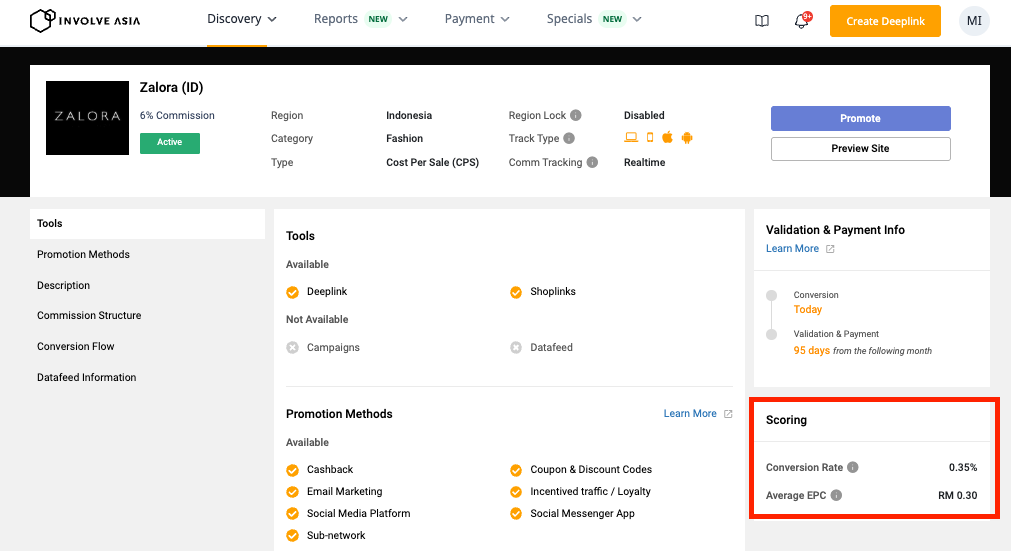
This helps publishers quickly understand how well a campaign is performing before promoting it.
Alongside EPC, publishers can also see the campaign’s conversion rate, giving deeper insight into how likely clicks are to convert into earnings.
By comparing both EPC and conversion rate, publishers can:
- Identify high-performing affiliate offers
- Choose campaigns with stronger earning potential
- Optimise traffic allocation more effectively
- Focus on offers that match their audience
This transparency helps publishers make smarter decisions and maximise affiliate revenue more efficiently.

Conclusion
Understanding what EPC is in affiliate marketing is essential for both beginners and advanced affiliates.
EPC helps measure campaign profitability, compare affiliate offers, and optimise performance more effectively. Whether you are promoting e-commerce products, finance offers, apps, or subscriptions, EPC is one of the most important metrics to track.
The higher your EPC, the more efficiently your traffic generates revenue.
Sign up as a publisher on Involve Asia today and discover affiliate campaigns with strong earning potential across Southeast Asia.
About the Author

Frequently Asked Questions (FAQs)
What does EPC mean in affiliate marketing?
EPC stands for Earnings Per Click. It measures how much money a publisher earns on average for every click generated through an affiliate link. EPC is calculated by dividing total earnings by total clicks. This metric helps publishers compare affiliate campaigns and identify which offers generate stronger revenue potential. Advertisers also use EPC to understand how attractive their affiliate programs are to publishers. A higher EPC usually indicates stronger conversions, better commissions, or higher-quality traffic.
How is EPC calculated in affiliate marketing?
EPC is calculated using a simple formula: total earnings divided by total clicks. For example, if a publisher earns $100 from 200 clicks, the EPC would be $0.50. This means each click generated an average of fifty cents in revenue. EPC helps affiliate marketers evaluate campaign profitability and compare different affiliate programs more effectively. Many publishers use EPC as one of the main metrics when deciding which campaigns to prioritise.
Why is EPC important for publishers?
EPC is important because it helps publishers understand which affiliate campaigns generate the highest revenue from their traffic. Instead of only focusing on clicks or conversion rates, EPC shows the actual earning efficiency of a campaign. Higher EPC offers allow publishers to maximise profits without necessarily increasing traffic volume. This is especially important for affiliates running paid traffic campaigns because stronger EPCs improve return on advertising spend and overall campaign profitability.
What affects EPC in affiliate marketing?
Several factors affect EPC, including conversion rate, commission size, traffic quality, product pricing, and audience intent. Campaigns with better landing pages, stronger offers, and highly targeted audiences usually produce higher EPCs. Industries like finance and SaaS often have higher EPCs because commissions are larger. Meanwhile, lower-margin ecommerce categories may produce lower EPCs even if conversion rates are strong. Publishers continuously optimise campaigns to improve EPC and maximise revenue efficiency.
How does Involve Asia help publishers improve EPC?
Involve Asia helps publishers improve EPC by giving them access to high-converting affiliate campaigns across Southeast Asia. Publishers can compare offers, track performance in real-time, and identify campaigns with stronger earning potential. The platform supports multiple commission models, including CPS, CPA, CPL, and CPI, allowing affiliates to diversify their revenue streams. By using performance insights and working with trusted brands, publishers can optimise traffic and improve overall affiliate marketing profitability.