This article was last updated on:
Affiliate marketing is known as a low-risk channel. But it is not completely free.
If you plan to start an affiliate program, you need to understand the full cost structure.
This guide breaks it down clearly. It also shows how Involve Asia helps brands control costs while scaling across Southeast Asia.

What Do Brands Actually Pay in Affiliate Marketing?
Affiliate marketing costs usually come in two parts:
- Platform costs
- Performance costs
1. Platform Costs
To run an affiliate program, you need a platform.
With Involve Asia, brands typically pay:
- A one-time affiliate program activation fee
- A flat monthly subscription fee
These fixed costs support campaign setup, tracking, reporting, and access to our 1M+ publishers.
2. Performance Costs
This is where affiliate marketing stands out.
You pay publishers when they deliver results.
Common models include:
- Percentage per sale
- Fixed payout per conversion
No conversion means no publisher commission.
Example: How Affiliate Marketing Costs Work
Let’s say your product sells for RM100.
You set a 10% publisher commission.
For every sale:
- You pay RM10 to the partner
- You keep RM90 revenue before other costs
If there are no sales, you pay RM0 in commissions.
What Affects Affiliate Marketing Costs?
Commission Rate
Higher commissions attract more publishers. They can also increase promotion priority.
Product Pricing
Higher-priced products can support higher commissions.
Industry Competition
Competitive categories often need stronger publisher incentives.
Partner Type
Different publishers expect different payouts.
- Cashback platforms often drive high volume
- Content creators help build trust
- Deal sites convert price-conscious shoppers
- Performance marketers need a clear ROI
Affiliate Marketing vs Other Online Acquisition Channels
Affiliate Marketing
- Pay partners based on results
- Scale through creators and partners
- Track conversions clearly
- Lower upfront risk after platform setup
Paid Ads
- Pay for clicks, impressions, or views
- Spend before conversions happen
- Need constant testing and optimisation
- Costs can rise with competition
Key difference: With paid ads, you pay before results.
Read: Affiliate Marketing vs Paid Ads for Online Brands Growth
Organic Marketing
- Does not charge per click
- Requires content, SEO, and time
- Can take months to show results
- Compounds over the long term
Key difference: Organic marketing can be cost-efficient, but growth is slower.
Influencer Marketing
- Often requires upfront payment
- Can build strong trust fast
- Results vary by creator
- ROI can be harder to track
Key difference: Influencer marketing often pays for reach, not guaranteed sales.
Read: Affiliate Marketing vs Influencer Marketing for Beginners
Why Affiliate Marketing Is Cost-Efficient
Affiliate marketing combines scale, trust, and performance.
It can scale like paid ads. It builds long-term growth like organic marketing. It uses trusted voices like influencer marketing.
The main difference is simple. You pay publisher commissions when results happen.
Where Involve Asia Fits In
Involve Asia is a performance marketing platform built for Southeast Asia.
We help brands launch and scale affiliate programs with cost control.
With Involve Asia, you can:
- Access local publishers across SEA
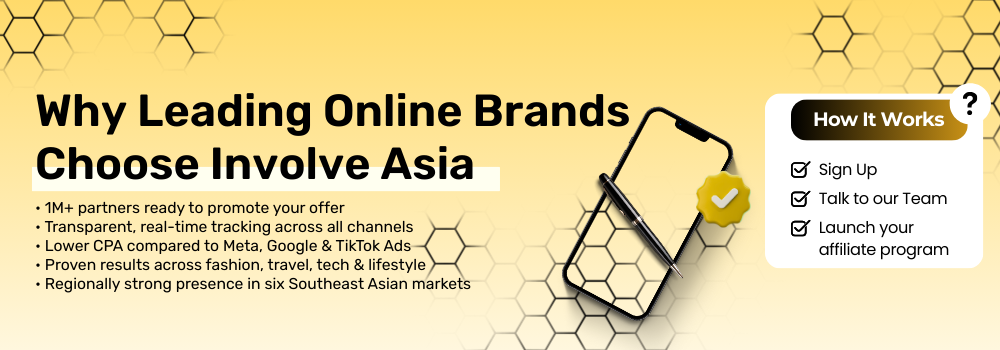
- Reach publishers in Malaysia, Singapore, Indonesia, Thailand, the Philippines, and Vietnam
- Launch campaigns in minutes
- Track conversions in real-time
- Set your own commission rates
- Pay publisher commissions when results happen
You get predictable platform costs and performance-based partner payouts.
Is Affiliate Marketing Worth the Cost?
Affiliate marketing works well when you want:
- Scalable growth
- Clear ROI
- Lower customer acquisition costs
- More reach across Southeast Asia
It is especially effective for e-commerce, travel, finance, and service brands.

Conclusion
Affiliate marketing is not free. But it is one of the most cost-efficient ways to grow online.
Paying publisher commissions based on results gives your brand control, flexibility, and scale.
Ready to launch a cost-efficient growth channel? Click the button below to register your interest today.
About the Author

Frequently Asked Questions (FAQs)
How much does affiliate marketing cost for brands?
Affiliate marketing costs vary depending on the commission structure and agency setup. Most brands operate on a performance-based model, meaning you only pay when a conversion happens, such as a sale or lead. Typical commissions range from 3% to 15% per sale, depending on the industry. There may also be platform or management fees, but overall, affiliate marketing is considered a low-risk channel because costs are directly tied to results.
What are the main costs involved in affiliate marketing for brands?
The main costs include publisher commissions, platform or network fees, and optional agency management fees. Commissions are the largest expense and are paid only when a conversion occurs. Some brands also invest in bonuses, exclusive deals, or higher commissions during campaigns to boost performance. Compared to paid ads, affiliate marketing offers more predictable and controllable costs because spending is tied to actual outcomes.
Is affiliate marketing cheaper than paid advertising for brands?
Affiliate marketing is often more cost-efficient than paid advertising because it operates on a pay-for-performance model. With paid ads, brands pay upfront for clicks or impressions, even if they don’t convert. In affiliate marketing, you only pay when a result is achieved. This reduces wasted spend and improves ROI, making it a strong option for brands looking to scale efficiently, especially in competitive markets.
Do brands need a large budget to start affiliate marketing?
Brands do not need a large upfront budget to start affiliate marketing. Since there are no fixed media buying costs, you can begin with a modest commission structure and scale as results come in. This makes affiliate marketing accessible for both small businesses and large enterprises. However, offering competitive commissions and incentives can help attract high-quality publishers and accelerate growth.
How can brands control affiliate marketing costs while scaling?
Brands can control costs by setting clear commission rates, defining conversion rules, and working with the right affiliate marketing platform or agency. Monitoring performance regularly helps identify top-performing publishers and optimise spend. Many brands also use tiered commissions or campaign-based incentives to balance cost and growth. With proper tracking and strategy, affiliate marketing remains one of the most scalable and cost-efficient channels available.